Holding Safety, Connection, and Hope: Child-Centered Play Therapy When Children Experience Domestic Violence
Written by: Samantha Long, PhD, LPC, RPT, NCC
Domestic violence rarely affects only one person.
It can shape the emotional landscape of an entire family. Sometimes quietly. Sometimes visibly. Oftentimes, in ways that are much more complicated than they appear from the outside. For children, experiences of violence between caregivers can influence how they come to understand safety, relationships, emotions, and the world around them. For the parent experiencing the violence, surviving may involve navigating fear, financial dependence, isolation, threats, concerns about custody, hopes that things will change, love for the person causing harm, attempts to protect their children, and countless other circumstances that someone outside of the relationship may never fully see.
This is important to name.
There can be tremendous stigma attached to the question, “Why didn’t they leave?”
But leaving an abusive relationship is rarely a simple event or decision. Sometimes leaving can increase danger. Sometimes a caregiver is carefully navigating safety in ways that are invisible to everyone around them. Sometimes they leave and return. Sometimes they are simultaneously trying to survive themselves while doing everything they know how to do to protect their children.
Compassionate, trauma-informed work requires us to hold the experiences of children without turning their caregiver’s survival into another source of blame. Instead, we can become curious about what everyone in this family has had to do to survive and what they might need to begin experiencing safety again.
Children Experience More Than What They See
Children do not have to physically be harmed themselves for violence in their environment to affect them. They may hear an argument from another room. They may notice a caregiver becoming frightened or unusually quiet. They may witness physical violence or threats. They may recognize subtle changes in someone’s voice, facial expression, or movements before anything visibly happens.
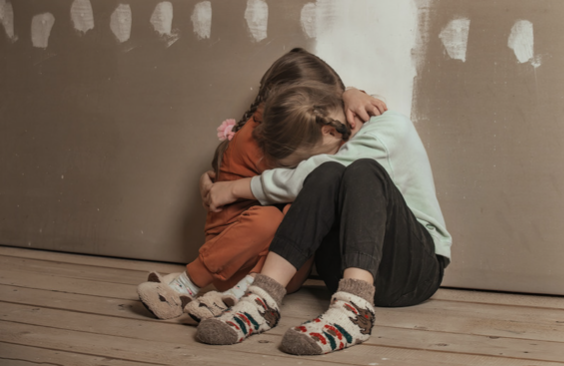
Some children hide.
Some become very quiet.
Some try to intervene.
Some care for younger siblings.
Some become intensely aware of everyone’s emotions.
Some continue playing as though nothing is happening.
There is no single way a child responds to domestic violence.
Children may not come into therapy and say: “I haven’t felt safe.” Instead, their bodies, relationships, behaviors, and play may begin telling parts of that story.
When the Nervous System Learns to Pay Attention
Children’s nervous systems are remarkably adaptive. As children grow, their brains and bodies are continually learning from the environments and relationships around them. When an environment becomes unpredictable or threatening, a child’s nervous system may become particularly attentive to information that helps them anticipate what might happen next.
Research offers an important window into this process.
Pollak and colleagues (2008) for example, found that abused children were able to recognize facial expressions of anger with less perceptual information than children without that history.
Think about what that can mean from a child’s perspective.
A slight change in someone’s face.
A shift in tone.
A particular movement.
Something another person might barely notice can become incredibly meaningful when recognizing anger has previously helped you anticipate what comes next. The child’s nervous system learned to notice what it needed to notice.
The challenge is that these protective responses may continue even when the child enters environments or relationships that are safer. A child may appear hypervigilant, easily startled, controlling, aggressive, withdrawn, distracted, or intensely aware of other people’s emotions.
Instead of beginning with: “What is wrong with this behavior?” we might begin somewhere different:
“What has the child’s nervous system learned it needs to do to feel safe?”
Domestic Violence Can Shape the Experience of Relationships
Domestic violence is not only an experience of frightening events. It can also become a deeply relational experience. Children develop their earliest understandings of relationships through the people around them.
They learn:
What happens when someone is angry?
Can adults protect me?
What happens when someone I love is hurting?
Is it my job to make things better?
Can I need someone and still be safe?
Sometimes, children are holding seemingly contradictory experiences at once.
They may love a caregiver and fear them.
They may desperately want another caregiver to be okay while also feeling angry with them.
They may miss someone who has caused significant harm.
They may want their family together while simultaneously wanting the violence to stop.
Children do not need us to simplify these experiences for them. They need relationships spacious enough to hold their complexity.
That is one of the places where Child-Centered Play Therapy (CCPT) can be especially meaningful.
Why CCPT?
CCPT begins with full trust in children and in their capacity for growth. Rather than asking children to explain experiences that may not yet have words for or asking them to process those experiences according to an adult’s timeline, CCPT provides a developmentally responsive space in which children can communicate through their natural language of play (Landreth, 2023). Perhaps even more importantly, CCPT provides a relationship.
Relationship = Change Agent
For a child whose relational world has included unpredictability, fear, control, or violence, consider what it can mean to encounter an adult who is consistently different.
An adult who does not require the child to disclose.
Who remains emotionally present when the child’s feelings become big.
Who can tolerate anger without becoming frightening.
Who sets limits without withdrawing connection.
Who does not need to control the child’s story.
Who trusts the child’s capacity to move toward what they need.
Week after week, that consistency can offer a different relational experience. Not because the therapist tells the child that adults are safe, but because, slowly, the child has an opportunity to experience what safety within a relationship can feel like.
Play Gives Children Somewhere to Put What They Have Carried
Children do not necessarily process frightening experiences by sitting down and telling us a chronological story. They play.

A house may need to be protected.
Someone may always be watching.
A baby might need rescuing again and again.
Powerful characters may fight.
Someone small may suddenly become enormously strong.
A figure may be buried and uncovered, trapped and rescued, powerless and powerful.
Or the child’s play may seemingly have nothing to do with domestic violence at all. This distinction matters. In CCPT, we do not assume that a particular toy, behavior, or play sequence has one predetermined meaning. We remain curious about the individual child, their developmental level, culture, relationships, experiences, and patterns across time. But play provides children with a way to create distance from experiences that may feel too large, confusing, or overwhelming to approach directly.
Through play, children can externalize pieces of their internal world.
They can experiment.
Organize.
Repeat.
Change the ending.
Experience power.
Experience vulnerability.
Seek safety.
Create safety.
And sometimes simply experience the freedom of being a child. The therapist does not decide where the story needs to go. We create the relational conditions in which the child can discover where they need it to go.
From Protection Toward Agency
One of the things I find most powerful about CCPT is its underlying belief that children possess an inherent capacity toward growth. Trauma can understandably organize children around protection.
Watching.
Anticipating.
Hiding.
Fighting.
Freezing.
Appeasing.
Controlling.
Disconnecting.
Those responses may have served an important purpose. CCPT does not ask us to immediately take them away. Instead, we create enough relational safety that the child may eventually discover they do not need every protective strategy in every moment.
Within the playroom:
The child chooses.
The child leads.
The therapist follows.
Feelings can exist without overwhelming the relationship.
Limits are predictable.
Choices have meaning.
The child’s internal resources are trusted.
For children whose lives have included experiences of powerlessness or unpredictability, these seemingly small moments of agency can matter deeply.
Holding the Child and Caregiver Together

Supporting children who have experienced domestic violence also means remembering that healing rarely happens in isolation. In CCPT, parent consultation work is important and the sessions can look a number of ways: That work may involve caregivers understanding their child’s behavior through a trauma-informed lens, strengthening connection, rebuilding predictable routines, increasing moments of felt safety, and creating space for caregivers to understand their own responses without shame.
A caregiver may be healing, too.
They may be rebuilding their own sense of safety while trying to become a source of safety for their child. They may not always respond perfectly. None of us do. Our work is not strengthened by asking why a caregiver did not protect differently with information, resources, or safety they may not have had at the time.
It is strengthened when we ask: What does this child need now? What does this caregiver need to provide it? How can we support the relationship between them as they move forward together?
Creating Space for Something Different
Children who have experienced domestic violence may carry pieces of those experiences in their bodies, relationships, expectations, and play. So may the adults who love them. Healing does not require us to judge how someone survived. It asks us to become curious about what survival requires and what might become possible when safety, connection, and choice begin to grow. CCPT offers children a space where they do not have to find all the right words.
Where they do not have to take care of the adult in the room.
Where anger does not end the relationship.
Where limits can exist alongside connection.
Where they can explore power without being overpowered.
Where their story belongs to them.
Where, little by little, the relationship can offer a different experience of what being with another person can feel like.
Sometimes healing begins there. Not by asking a child or caregiver why they responded the way they did, but by understanding that they survived with the resources available to them and helping create enough safety for new possibilities to emerge.
References
Pollak, S.D. (2008). Mechanisms linking early experience and the emergence of emotions: Illustrations from the study of maltreated children. Current Directions Psychological Science, 17(6), 370-375. Doi: 10.1111/j.1467-8721.2008.00608.x.
Landreth, G. L. (2023). Play therapy: The art of the relationship (4th ed.). Routledge.