When Limits Become Connection: Rethinking Boundaries in Child-Centered Play Therapy
By: Holly Dudley, Resident in Counseling, NCC and Samantha Long, PhD, LPC, RPT, NCC
Limit setting can bring up a lot for adults because, at first glance, limits can feel like the opposite of connection.
For caregivers, limits often show up in the most exhausting moments. The bedtime battle. The sibling conflict. The toy being thrown across the room. The child who is already overwhelmed, and the adult who is trying so hard to stay calm.
For therapists, especially Child-Centered Play Therapists, limit setting can feel difficult in a different way. We want to honor the child’s process. We want to stay child-centered. We do not want to become controlling, punitive, or directive.
Limit Setting is Often The Therapy
It is worth saying this plainly: in Child-Centered Play Therapy, limit setting is not a pause in the therapeutic work. It is not an interruption. It is not a necessary inconvenience. Limit setting is often the therapy itself… Think about what a child is actually experiencing when a limit is set well. They push. The adult stays steady. They may escalate. The adult remains calm and present. They test whether the boundary will disappear if they push hard enough. It does not. Through that entire experience, the child learns something that cannot be taught with words alone.
They learn that frustration is survivable. That they will not be abandoned when they are experiencing big emotions and maybe engaging in outbursts/meltdowns/tantrums. That adults can be trusted to be consistent and predictable. That the world has a structure they can lean into rather than fight against. Limits also teach children to understand a space….what it is for, what is expected, and what they can count on or plan for. This is fundamentally different from simply being told “no.” A limit that is set with warmth and clarity helps a child develop an internal map of the world around them. Over time, they do not just follow the rule. They begin to understand it. They internalize it. That internalization is growth.
Predictability. Consistency. Frustration Tolerance. A Felt Sense of Safety.
This is what limits can offer….
A limit can communicate: “I am still with you. Your feelings are allowed. And I will help keep this space safe.” This is very different from: “You are too much.”
Children often test limits where they are looking for safety.
When a child pushes against a boundary, it can be easy to see only the behavior.
The hitting.The throwing.The yelling.The refusing.The running away.The “no.”
But underneath the behavior, there is often a question.
Are you still here when I am angry?Can you handle this part of me?Will the boundary stay the same if I push against it?Can I trust you to keep me safe?
Children do not usually ask those questions with words. They ask with their behavior, their play, their bodies, and their intensity. This does not mean every behavior is okay. It means we stay curious about what the behavior may be communicating while still holding the limit. That balance is so important.
Connection Comes Before Correction
When a child is already overwhelmed, correction alone often does not reach the part of the brain that can listen, problem-solve, or make a different choice.
Many caregivers know this moment well.
You explain the rule.You explain it again.You try to stay patient.The child gets louder.You get more frustrated.And suddenly, it feels like everyone is stuck in a power struggle.
This is why connection matters so much.
Connection does not mean there are no rules. It does not mean the child gets to do whatever they want. It means we reach for the relationship before we reach for correction.
Sometimes connection sounds like:
“You really wanted more time.”
“You are so mad that it did not go your way.”
“You wanted that toy, and waiting feels hard.”
“You were not ready to stop.”
These simple moments of connection help the child feel seen before they are redirected.
Limits Do Not Have to be Harsh to be Clear
One of the things we love about Child-Centered Play Therapy is that it gives us language for holding both compassion and clarity. The ACT model, developed by Garry Landreth (Landreth, 2023), is often used in play therapy and Child Parent Relationship Therapy as a way to set limits while keeping the relationship at the center.
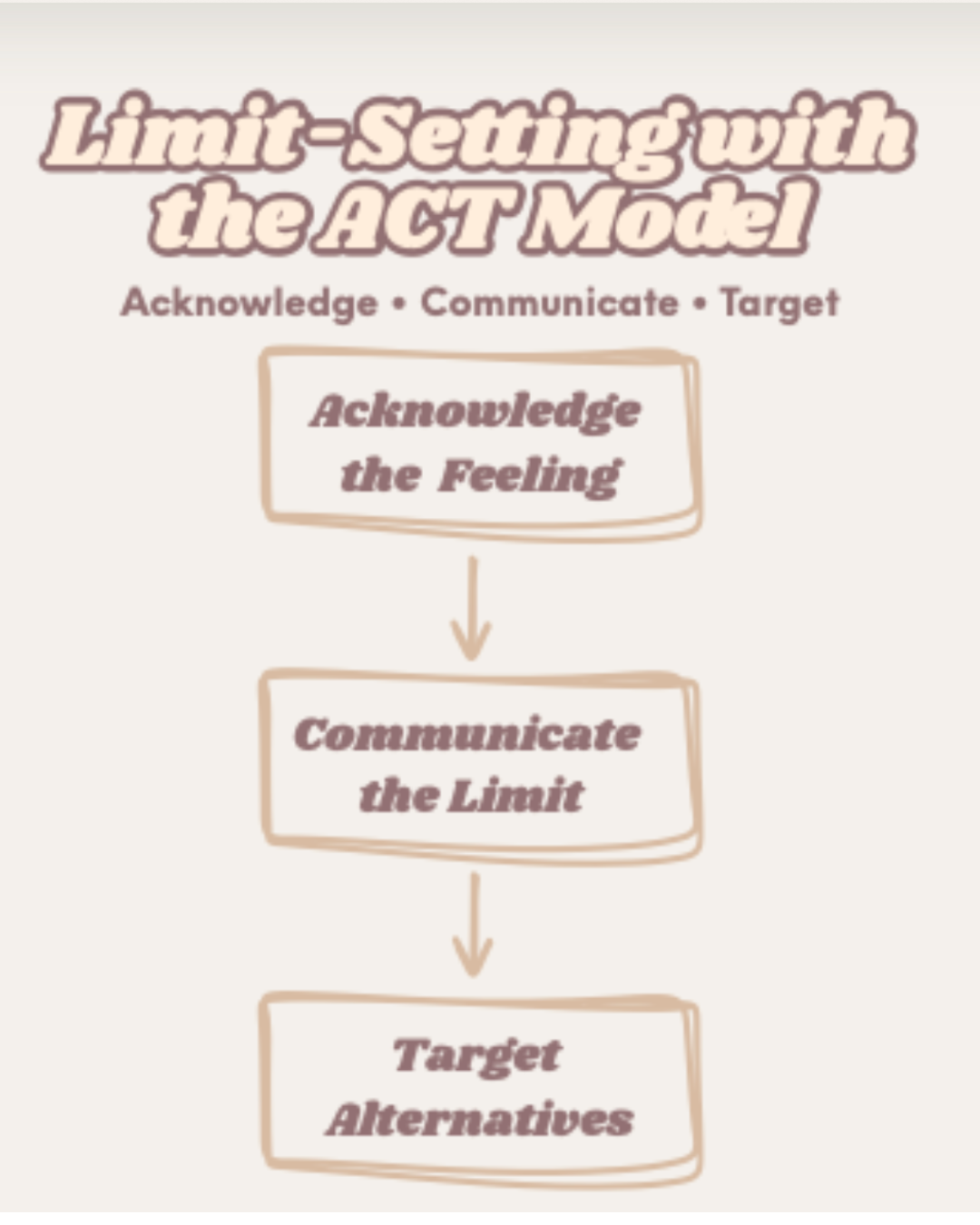
ACT stands for:
Acknowledge the feeling.“You are really angry.”
Communicate the limit.“Your sister is not for hitting.”
Target an acceptable alternative.You can tell her: ‘I’m mad” or “squeeze this pillow.”
At home, this might sound like:
“You really want more TV. The TV goes off at 7:30. You can draw or pick a game.”
“You do not want to go to bed. It is bedtime. You can choose a book or a stuffed animal.”
“You are frustrated and want to throw. The blocks are not for throwing at people. You can throw this soft ball into the basket.”
These responses are not magic words. They do not guarantee that a child will suddenly smile and say, “Thank you for your thoughtful limit. I will now regulate myself.”
But over time, they create a pattern…
The child experiences an adult who can notice their feelings, hold the boundary, and offer another way. That is how children begin to internalize safety and can make sense of the world around them.
A Note on Gentle Parenting
When caregivers or therapists encounter language like, "acknowledge the feeling,” or “offer an alternative,” they sometimes wonder whether this is gentle parenting practices with a different name. It is a fair question, and it deserves a direct answer.
It is not.
Gentle parenting, as it is often understood in popular culture, has sometimes been interpreted as an approach that avoids discomfort, minimizes consequences, and allows a child to “walk all over the caregiver.” At its most misapplied, it can look like endlessly negotiating limits, avoiding follow-through, giving in, or removing all sources of frustration before a child has a chance to encounter them.
That is not what we are describing here.
Using the ACT model in a calm tone of voice does not make it gentle parenting. Acknowledging a child’s feelings before setting a limit is not the same as giving them whatever they want. Staying regulated in a hard moment is not the same as avoiding the hard moment. Children need rules. They need structure. They need adults who will hold limits even when it is uncomfortable, even when the child protests, even when the adult is tired. Limits are not a failure of warmth; they are an expression of it.
What CCPT asks of us is not that we remove limits but that we hold them differently. With more awareness…with more attunement…with less shame and guilt and less reactivity. The limit is still there. The follow-through is still therapy. What changes is the quality of our presence while we hold it.
In the Playroom, Limits are Therapeutic Too
In the playroom, limit setting can feel especially important because the child’s play is their language. Children may use play to express anger, power, fear, control, chaos, protection, or hurt. Sometimes that expression becomes intense.
A child may want to throw something at the therapist.Break a toy.Use materials in a way that becomes unsafe.
In those moments, the limit is not separate from the therapy…It is part of the therapy.
The child gets to experience an adult who does not shame them for the feeling, but also does not abandon the boundary.
The child gets to learn:
My anger can be understood.My intensity does not scare this adult away.There are boundaries here.This space is safe enough to hold me.
That is powerful.
Because many children are not only testing the rule. They are testing the relationship.
When the Limit Does Not “Work”
Sometimes we set a limit calmly and beautifully, and the child still pushes right past it. That does not always mean we did it wrong. Children often need repeated experiences with consistent limits before they begin to trust them. Especially if they are tired, hungry, stressed, anxious, overstimulated, or dysregulated, they may not be able to access a better choice right away.
This is where adults often need support too.
It can be hard to stay steady when a child keeps pushing. It can be hard not to take it personally. It can be hard not to move into too many words, too much explaining, or a consequence we do not actually want to follow through with.
A helpful reminder is to only offer choices you can hold. In Child Parent Relationship Therapy, limit setting is often framed around helping children experience responsibility for their choices in a safe, relational way. The adult does not need to shame, lecture, or overpower the child. Instead, the adult clearly names the choice and follows through calmly when needed (Bratton et al., 2006; Landreth, 2023).
“If you choose to keep throwing the toy, you choose to be all done with the toy.”
Then, if the child keeps throwing, the toy is calmly put away.
Not with shame.Not with a lecture.Not with anger.
Just with follow-through.
The calm follow-through is part of what makes the limit feel safe. Over time, children begin to learn that limits are not random, threatening, or dependent on the adult’s mood. They are predictable. They are held with care. And they help the child feel the connection between their choices and what happens next.
Limit Setting Asks Something of the Adult Too
Limit setting is not only about what the child is doing. It also invites us to notice what is happening inside of us.
Do I feel anxious when a child is angry?Do I feel pressure to stop the behavior quickly?Do I avoid limits because I do not want the child to be upset with me?Do I become too firm because I feel out of control?Do I trust myself to hold the boundary with warmth?
These are important questions for caregivers and therapists.
Because the words matter, but our presence matters too. Children feel the difference between a limit set from panic and a limit set from groundedness. They feel the difference between control and care. They feel the difference between rejection and safety.
When we can set a limit while staying connected, we offer the child something they can carry with them far beyond that moment…
Want to Go Deeper? Upcoming Training: The Limit as Therapy
At Integrated Play Connections, we believe limit setting is one of the most important and often under-supported parts of Child-Centered Play Therapy. Our upcoming training explores limit setting not as behavior management, but as a relational and therapeutic part of the play therapy process. We will look at the ACT model, the therapist’s use of self, common moments that bring up uncertainty, and how to hold limits in a way that stays grounded in Child-Centered Play Therapy.
This live online training will take place on Friday, June 12, 2026 from 9:00 AM–12:15 PM EST. Together, we will explore limit setting through a Child-Centered Play Therapy lens, with attention to how limits can support safety, consistency, choice, responsibility, and connection in the playroom.
Date: Friday, June 12, 2026Time: 9:00 AM–12:15 PM EST
Location: Online
Hosted by: Integrated Play Connections Therapy Center
Registration: The Limit As Therapy
References
Landreth, G. L. (2023). Play therapy: The art of the relationship (4th ed.). Routledge. https://doi.org/10.4324/9781003255796
Bratton, S. C., Landreth, G. L., Kellam, T., & Blackard, S. R. (2006). Child parent relationship therapy (CPRT) treatment manual: A 10-session filial therapy model for training parents. Routledge.