Beyond Tracking: Reflecting Intention and Understanding Themes in Child-Centered Play Therapy
By: Michelle Walker, LCSW, RPT-S
Play themes are one of those areas in play therapy that we do not seem to talk about nearly enough. We spend significant time learning the foundational skills of Child-Centered Play Therapy (CCPT), such as tracking, reflecting feelings, returning responsibility, facilitating creativity, and setting limits. Yet, much less time is spent focusing on exploring what children may be communicating through the patterns and themes that emerge in their play.
It is important to note that understanding play themes is not about interpreting a child’s play, nor do we need to determine exactly what the play “means” for CCPT to be effective. In fact, Ray (2011) suggests that focusing too heavily on the identification of themes may distract the therapist from remaining fully present and engaged in the therapeutic relationship with the child. The healing factor in CCPT remains the therapeutic relationship.
Instead, identifying themes can deepen the therapist’s conceptualization of the child while remaining grounded in the child’s lived experience and the therapeutic relationship. This deeper understanding can help guide the therapist’s reflections during play, inform discussions in parent consultations, assess therapeutic progress, and support accurate progress-note documentation (Ray, 2011).
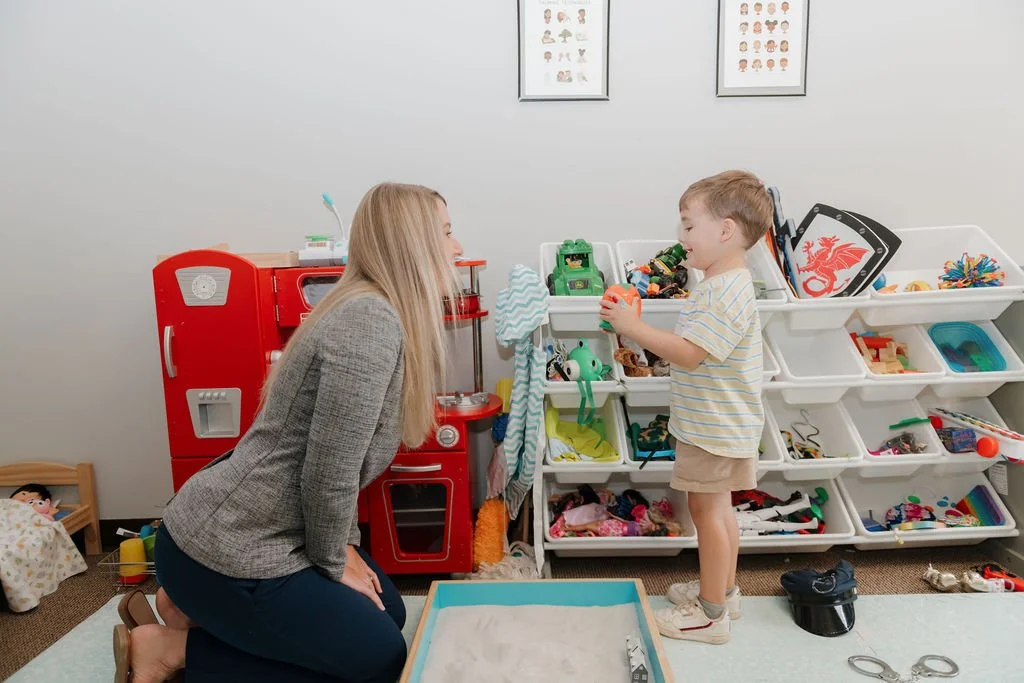
We become better at listening to what the child is actually communicating, which helps us more fully embody Garry Landreth’s central “be-with” attitude: I am here. I hear you. I understand. I care.
And that is where theme work becomes deeply connected to the core conditions of CCPT.
Children Rarely Say Only What They Mean
If you spend enough time around children, you learn pretty quickly to listen between the lines. A child might yell, “I don’t care!” But depending on the child, the relationship, and the moment, underneath those words might be:
I care so much that this hurts.
I don’t want you to know how disappointed I am.
I need to know whether you still care even when I pretend I don’t.
We do not necessarily respond by explaining that deeper meaning to the child. We listen for it. We reflect in a way that builds self-awareness, understanding, empathy, and acceptance.
Play provides children with a developmentally responsive way to communicate their inner worlds. Within CCPT, play serves as a language through which children can express experiences, emotions, relationships, conflicts, and needs that may be too difficult, or not yet accessible, to put into words. The child is not sitting in the playroom searching for the perfect sentence to describe an internal experience they may not yet have the cognitive language to articulate. They play it, draw it, act it out, or communicate it in protective ways.
Play Behaviors: The What
One helpful distinction is between play behaviors and play themes. Play behaviors are what we can observably see happening in the playroom; they are the what of the play. However, the same play behavior can emerge for many different reasons and may hold very different meaning depending on the child and the context. Ray (2011) uses aggression as an example of a play behavior that, on its own, offers little insight into understanding the child more fully.
For example, if a child puts handcuffs on the therapist, the objective behavior is that the child contained the therapist. We can observe that behavior without immediately assigning meaning to it. Other observable play behaviors might include rescuing, burying, crashing, hiding, caring for self or others, defeating, capturing, building, destroying, protecting, separating, or repeatedly organizing objects. These behaviors give us pieces of information, but they are not necessarily the whole story.
Play Themes: The Larger Story
Play themes move us beyond simply noticing what happened and help us become curious about the larger metaphor or emotional story developing across the child's play. Ray (2011) dedicates an entire chapter of Advanced Play Therapy to themes in play therapy, describing theme work as one of the more advanced skills involved in CCPT practice. Research on nondirective play therapy has likewise explored how therapists can distinguish broader themes from the specific contents of children's play (Ryan & Edge, 2012).
Return to our child with the handcuffs. The behavior is containment. But what is happening underneath it? Perhaps the larger play is about power and control. Maybe it is about safety. Or, perhaps it is relational: Will you still accept me when I act this way? Maybe it is about revenge or retaliation: Now you know what it feels like to be powerless. Or perhaps it represents something entirely different for this particular child.
And this is exactly why themes should create curiosity, not certainty. The goal is not to decide:
“Handcuffs mean power and control.”
That moves us away from the phenomenological world of the child and toward our own interpretation of it. Instead, we stay with the child. We notice the behavior. We remain attentive to patterns. We listen to the emotional tone. We pay attention to what happens before and after. And, importantly, we trust the felt sense of the play.
From Play Theme to Play Intention
For me, one of the most clinically meaningful questions I have learned to ask myself over the years is: What is this child trying to help me know about them, hear, or understand right now? This is what I think of as the intention of the play.
It is not necessarily the historical reason the child is playing something. It is not our attempt to diagnose the meaning of a miniature, determine what a character “really represents,” or uncover a hidden story. Instead, it asks us to become more attuned to what the child is communicating within this moment and within this relationship. From that attunement comes the deeper reflection, a response that communicates empathic understanding, supports congruence, and conveys unconditional positive regard. When the child experiences these core conditions more fully, they are given greater freedom to explore and accept their internal experience, strengthen their sense of self, and access the inner resources that support growth and change.

Imagine the child has handcuffed the therapist, throws the key across the room, stands tall, and says: “Now you can NEVER get out!” A surface-level tracking response might be: “You put the handcuffs on me and threw the key away.” Accurate? Absolutely.
But if the therapist senses the intensity, power, and significance within that moment, a deeper response may be warranted and sound more like: “You’re the one who gets to decide what happens.” - Intention is about the child having control.
Or: “You want to make sure I am not going anywhere.” - The intention is relational: trust vs. mistrust.
We are no longer simply reflecting the mechanics of the play. We are communicating:
I am right here with you, fully listening, fully present, fully accepting.
Why This Matters in CCPT
This is where understanding themes becomes so much more than an advanced clinical skill. It becomes another way of offering the core conditions.
When we take the time to truly listen to a child, to notice not only what they are doing, but also the emotional experience underneath it, we strengthen our capacity for empathic understanding. When a child repeatedly experiences an adult who is trying to understand their internal world without judging it, correcting it, directing it, or demanding that they explain it, something powerful happens. They are given greater permission to experience themselves.
The angry parts. The scared parts. The powerful parts. The vulnerable parts. The nurturing parts. The parts that want to destroy everything and the parts desperately trying to put everything back together again. All of it can exist within the relationship.
Within the person-centered foundation of CCPT, it is through an accepting, genuine, empathic relationship that children are supported in moving toward more integrated and self-enhancing ways of being. This is why deeper reflections matter. Not because we found the “correct” interpretation. But because, for a moment, the child experiences: You understand me.
And through repeated experiences of being deeply understood and fully accepted, the child is given space to begin understanding and accepting themselves. More congruence. Greater self-acceptance. Increasing access to their own inner resources. And movement toward growth.
We Don't Have to Solve the Play
Perhaps one of the most important things to remember about play themes is that we do not have to solve them. We don't need to decode every miniature. We don't need to identify a theme in every session. We don't need to turn nondirective play into an elaborate guessing game about what everything symbolizes. Sometimes a handcuff is simply a handcuff.
Our responsibility is not to be the smartest person in the playroom. Our responsibility is to stay with the child. Notice. Listen. Remain curious. Trust the process. And when the child's play invites us a little deeper, have enough understanding of the language of play that we can meet them there.
Because ultimately, understanding themes isn't about knowing more about the child. It's about helping the child feel more deeply known.
References
Landreth, G. L. (2024). Play Therapy: The Art of the Relationship (4th ed.). Routledge, New York, NY.
Ray, D. C. (2011). Advanced play therapy: Essential conditions, knowledge, and skills for child practice. Routledge.
Ryan, V., & Edge, A. (2012). The role of play themes in non-directive play therapy. Clinical Child Psychology and Psychiatry, 17(3), 354–369.