Looking Beneath “Defiance”: Understanding the Need Behind the Behavior
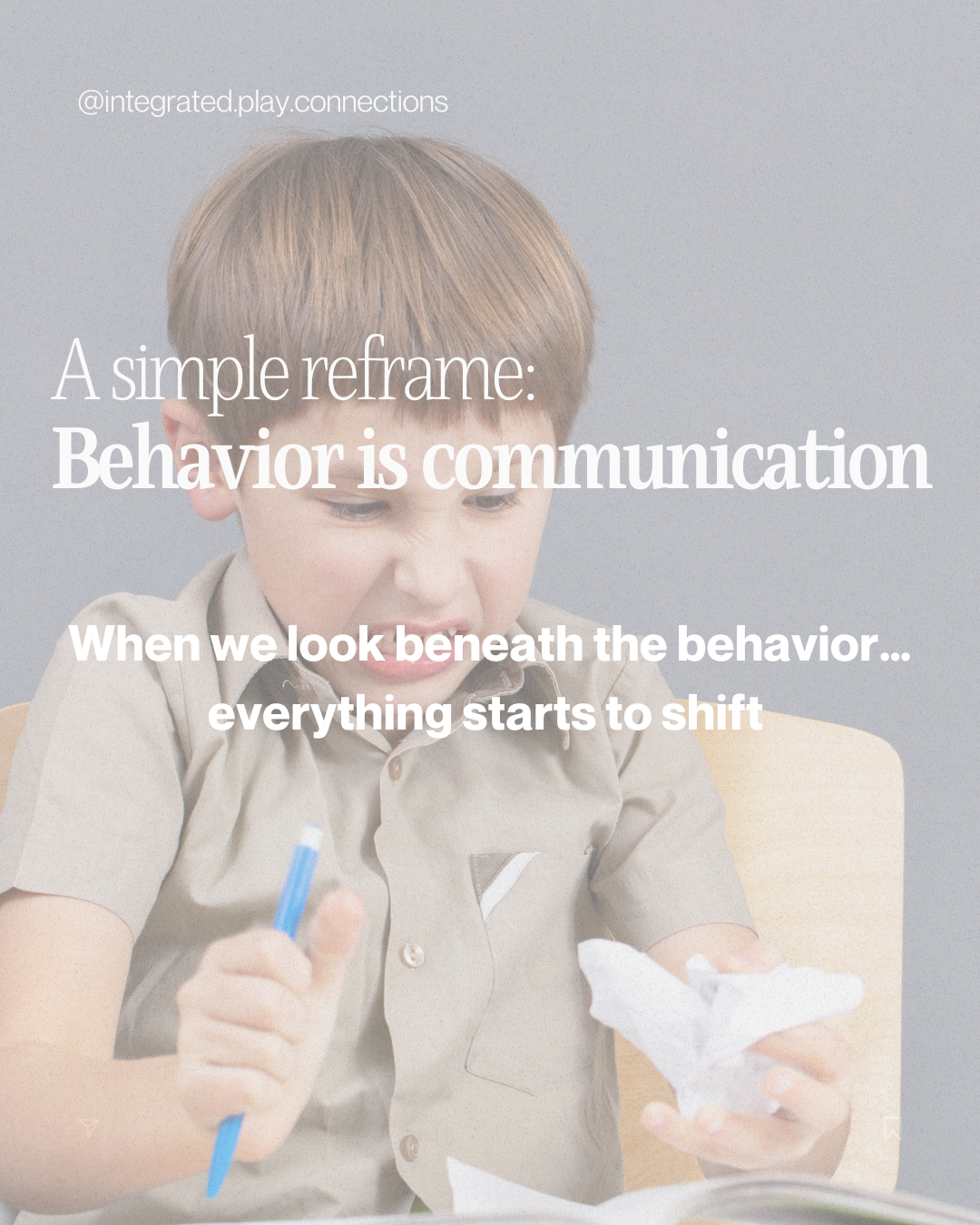
At some point, almost every parent has said to themselves, “Why are they being so defiant?”
Maybe it looks like:
Refusing
Arguing
Pushing back
Escalating quickly
Power struggles that seem to come out of nowhere
But what if “defiance” isn’t the whole story? At Integrated Play Connections, we offer a simple reframe. Behavior is Communication. When we begin looking beneath the behavior, everything starts to shift.
What We Often Call “Defiance”
From a child-centered perspective, what we label as defiance is often a child’s best available form of communication.
Children don’t yet have the words, insight, or nervous system regulation to say:
“This feels overwhelming.”
“I feel powerless.”
“I need help slowing down.”
“I don’t feel safe right now.”
So instead, they show us through behavior.
Child-Centered Play Therapy (CCPT) views behavior not as something to eliminate or control, but as meaningful communication reflecting a child’s internal emotional and physiological experience (Landreth, 2012). Rather than viewing behavior as “good” or “bad,” Child-Centered Play Therapy sees it as a child’s best attempt to adapt using the skills and nervous system capacity they currently have.
Instead of asking: “How do I stop this behavior?”
We begin asking: “What might this behavior be telling me?”
Possible Needs Beneath the Behavior
When we look beneath “defiance,” we often find:
A need for autonomy or control
Overwhelm or sensory overload
Difficulty with transitions
Disconnection or insecurity
For example:
The child who refuses to leave the playground may feel powerless. The child who explodes at bedtime may be overwhelmed by transitions. The child who argues constantly may be searching for connection in the only way they know how.
When we shift from control to curiosity, our response changes.
What’s Happening in the Brain During “Defiant” Moments?
When a child feels overwhelmed or emotionally flooded, the brain shifts into survival mode.
The thinking brain, the prefrontal cortex, goes offline. Fight, flight, or freeze responses take over.
In these moments, children are less able to reason, problem-solve, or cooperate, even if they “know better.”
Neuroscience shows that children must feel regulated and safe before they can access learning, self-control, and reflection (Perry & Szalavitz, 2017; Siegel & Bryson, 2016). A dysregulated brain cannot cooperate.
This is why connection must come before correction.
Research in attachment and brain development demonstrates that children learn emotional regulation through co-regulation with safe adults, not through fear, pressure, or control (Siegel, 2020). When caregivers respond with emotional presence, calm tone, and empathy, a child’s nervous system begins to settle.
Dr. Bruce Perry describes this sequence as:
Regulate → Relate → Reason (Perry, 2006).
Regulation comes first. Relationship creates safety. Reasoning becomes possible afterward.
What Happens Inside You as a Parent?
Your child’s dysregulation activates your nervous system too.
You may notice:
Fight (arguing, lecturing)
Flight (shutting down, walking away)
Freeze (feeling stuck or overwhelmed)
When both parent and child are dysregulated, power struggles escalate quickly. Control becomes the focus. Connection feels unavailable. This is not a parenting failure; this is a biological response. The goal is not perfection. The goal is awareness, regulation, and repair.
A Simple Framework for Responding: The ACT Model
One practical tool we teach parents comes from Garry Landreth’s work in play therapy (Landreth, 2012). The ACT Model provides a simple, research-informed way to respond to challenging behavior while staying aligned with child-centered and neuroscience principles.
A — Acknowledge the Feeling
Name what the child may be experiencing emotionally.
“You’re really upset about having to stop.”
“You’re frustrated that it’s time to turn it off.”
Acknowledging feelings helps a child feel seen and understood.
C — Communicate the Limit
State the boundary clearly and calmly, grounded in neutrality, communicating the limit without criticism, blame, or emotional escalation.
“I am not for hitting.”
“It’s time to turn the tablet off.”
Limits provide safety and predictability.
T — Target Alternative Choices
Offer acceptable ways for the child to meet the same need or express the same feeling.
“You can hit the pillow instead.”
“You can choose to hand it to me or put it in the charger.”
This step teaches problem-solving, emotional expression, and behavioral flexibility. The ACT Model allows you to hold limits without overpowering. It reduces shame for children and you as the parent as well.
Support Between Therapy Sessions: Our Resource Library
We also know that real-life parenting happens in the in-between moments, the after-school meltdowns, the bedtime battles, the rushed mornings.
This is why we created our Resource Library
Inside, you’ll find practical, connection-based tools grounded in the same principles we use in therapy, including:
Behavior-as-communication guides
Co-regulation strategies
Scripts for setting limits with empathy
Tools for tracking emotional themes
Printable supports for home and school
These resources are designed to help you respond with confidence, even when things feel hard.
https://www.integratedplayconnections.com/resource-library/caregiver-resources
A Different Way of Seeing Behavior
When we look beneath defiance, rather than seeing a “problem child”, we see a child with a need, and a nervous system asking for support. And often alongside that, we see a parent who is exhausted and trying their best to meet those needs. When behavior feels hard, it is not a sign that you are doing something wrong as a parent. It is often a sign that something underneath needs support.
When Additional Support May Be Helpful
You might consider seeking additional support if:
Big emotions feel frequent, intense, or hard to soothe
Power struggles are constant and exhausting
Your child seems anxious, withdrawn, or easily overwhelmed
Transitions (school changes, separation, new siblings) feel especially difficult
Behavior has dramatically changed after stress, loss, or difficult experiences
You feel unsure about how to support your child emotionally
How We Can Support Your Family
At Integrated Play Connections Therapy Center, we offer:
Child-Centered Play Therapy for children ages 3-12
Parent support and consultation
Connection-based, developmentally informed care
Play therapy gives children a safe space to express what they cannot yet put into words. Parent sessions provide guidance, tools, and support without shame or judgment. If you are feeling overwhelmed, stuck in power struggles, or unsure how to support your child’s big emotions, we are here to help.
Works Referenced
Landreth, G. L. (2012). Play therapy: The art of the relationship (3rd ed.). Routledge.
Perry, B. D. (2006). Applying principles of neurodevelopment to clinical work with maltreated and traumatized children: The Neurosequential Model of Therapeutics. In N. B. Webb (Ed.), Working with traumatized youth in child welfare (pp. 27–52). Guilford Press.
Perry, B. D., & Szalavitz, M. (2017). The boy who was raised as a dog (3rd ed.). Basic Books.
Siegel, D. J. (2020). The power of showing up: How parental presence shapes who our kids become and how their brains get wired. Ballantine Books.
Siegel, D. J., & Bryson, T. P. (2016). No-drama discipline: The whole-brain way to calm the chaos and nurture your child’s developing mind. Bantam.